Which ACFT Age Brackets Do You Fall Into?
If you are searching for ACFT age brackets, you probably want one clear answer: which scoring table applies to you, how age affects your points, and whether the Army still uses the ACFT at all. The short version is that ACFT scoring was built around age-normed brackets, so the raw performance needed for the same score can change depending on your age group. That matters because the Army later replaced the ACFT with the Army Fitness Test (AFT) on June 1, 2025, and the current system now uses different standards depending on duty category.
This article breaks the brackets down in plain English, shows how the scoring bands work, and explains the most important update most people miss: the ACFT is now a legacy test, but its age brackets still matter for understanding older scorecards, historical records, and how Army fitness standards evolved.
ACFT Age Brackets at a Glance
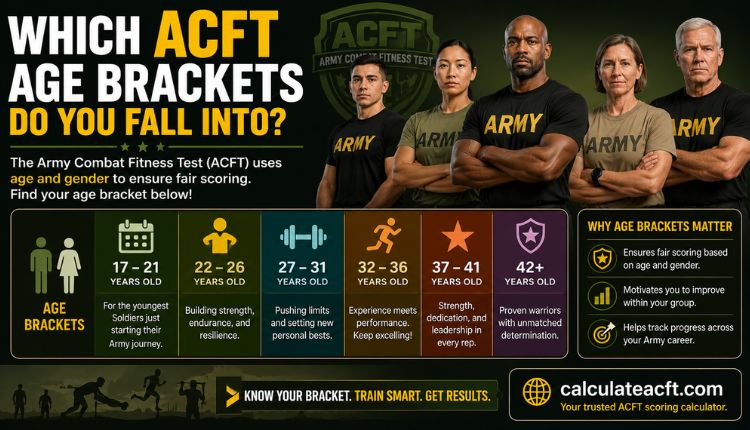
The official ACFT age brackets used the same age bands across the test’s events. The brackets were: 17-21, 22-26, 27-31, 32-36, 37-41, 42-46, 47-51, 52-56, 57-61, and Over 62. Those age groups appear across the official ACFT scoring tables for the deadlift, sprint-drag-carry, plank, two-mile run, and alternate aerobic events.
| ACFT age bracket | Notes |
| 17-21 | Youngest official scoring band |
| 22-26 | First adult bracket after 21 |
| 27-31 | Common bracket for early-career Soldiers |
| 32-36 | Mid-career age group |
| 37-41 | Older-adult scoring band |
| 42-46 | Higher age-normed bracket |
| 47-51 | Senior-service bracket |
| 52-56 | Later-career bracket |
| 57-61 | Near-retirement bracket |
| Over 62 | Oldest official ACFT age band |
These brackets are not random labels. They are the framework the Army used to compare Soldiers against age-adjusted standards rather than a single flat raw-score target for everyone.
What the Brackets Actually Change
The big idea behind ACFT age brackets is simple: the same raw performance can score differently depending on age group. In the ACFT tables, the two-mile run makes this easy to see. For example, the 60-point threshold for the men’s run starts at 22:00 in the younger brackets, but rises to 23:36 in the 57-61 and Over 62 groups; the women’s 60-point threshold also shifts across age bands, reaching 25:00 in the Over 62 group. That means the bracket changes the score conversion, not just the label at the top of the page, visit more.
That is the part many people misunderstand. Age brackets do not mean the event becomes meaningless, and they do not mean every standard is softened in the same way. They mean the Army used different scoring curves so the same event could be interpreted against age-specific expectations. If you are comparing scores across Soldiers, you need to compare both the raw performance and the correct bracket.
Why the Army Used Age-Normed Scoring
The Army’s own explanation is that age-normed scoring acknowledges the force’s demographics and the physiological demands Soldiers face across a career. On the current Army Fitness Test page, the Army says this approach balances the need for experienced personnel with performance expectations and recognizes that older Soldiers often serve in less physically demanding roles.
That is the key logic behind the ACFT age brackets too. The Army was not trying to create a “good enough” test. It was trying to build a scoring model that reflected age-related performance differences while still keeping a demanding standard. In other words, age norming was a calibration tool, not a shortcut.
ACFT vs. AFT: What Changed
This is the update you cannot ignore. The Army says the Army Fitness Test (AFT) became the official physical fitness test of record on June 1, 2025, replacing the ACFT. The AFT keeps age-normed scoring for combat-enabling specialties, while combat specialties use one sex-neutral, age-normed standard that requires 350 total points and at least 60 points per event. The Army also said no administrative action would be taken regarding the AFT until January 1, 2026.
So if you are reading about ACFT age brackets today, the right way to think about it is this: the ACFT bracket system is still important for legacy scorecards, older training material, and historical comparisons, but it is no longer the Army’s current test of record. For active use, the Army has moved to the AFT framework.
How to Use the Brackets Correctly
The safest way to use the ACFT age brackets is to follow a simple sequence.
First, make sure you are looking at the correct test version, to know more information. If the scorecard is from before June 1, 2025, you are dealing with ACFT standards; after that date, the Army’s test of record is the AFT.
Second, match your performance to the right age band before you compare scores. The ACFT tables are built around the age groups listed above, and each event uses those same bands across the scoring scales.
Third, focus your training on the events that create the biggest gap between your current performance and the bracket-specific target. That approach is more useful than chasing a single total score in isolation, because the score conversion is event-based and bracket-based.
Common Mistakes Soldiers Make
One common mistake is using an outdated chart and assuming the numbers still match the current ACFT age brackets standard. They do not, because the Army moved from ACFT to AFT on June 1, 2025.
A second mistake is treating the age bracket as a formality. It is not. On the ACFT, your age band can change the raw performance needed for the same point score, especially in endurance events like the two-mile run.
A third mistake is comparing raw results from different age groups as if they came from the same table. If one Soldier is in the 22-26 band and another is in the 47-51 band, the scoring conversion is not identical, so the comparison needs context.
FAQs
What are the ACFT age brackets?
The official ACFT age brackets were 17-21, 22-26, 27-31, 32-36, 37-41, 42-46, 47-51, 52-56, 57-61, and Over 62.
Is the ACFT still the Army’s test of record?
No. The Army says the AFT replaced the ACFT as the official test of record on June 1, 2025.
Do all ACFT events use the same age groups?
Yes. The official scoring scales show the same age bands across the deadlift, sprint-drag-carry, plank, two-mile run, and alternate aerobic events.
Why are ACFT scores age-normed?
The ACFT age brackets used age-normed scoring to account for demographics and changing physical demands across a Soldier’s career while keeping the standard aligned with readiness.
Did the Army lower standards for older Soldiers?
Not in a simple sense. The scoring tables adjust raw targets by age, but the test still measures performance and still expects Soldiers to meet the standard for their bracket.
Where can I find the official ACFT scoring tables?
The official ACFT scoring scales were published by the Army in PDF form, and they list the raw-score conversions by age group for each event.
Are old ACFT scores still useful?
Yes, for legacy records, comparisons, and understanding old scorecards. But if you are testing today, the Army’s current system is the AFT.
Conclusion
If you were looking for ACFT age brackets, the most important takeaway is this: the official ACFT used ten age bands, and those bands changed the raw score needed for each point conversion. That is why the bracket matters so much when you read an old scorecard or compare performance across Soldiers.
Just as important, the Army has now moved on to the AFT, so current testing should be interpreted through the new standard, not the old ACFT framework. If you are training or comparing records, always check the test date first, then use the correct scoring system, and only then look at the age bracket. That is the cleanest way to avoid bad comparisons and wasted effort.