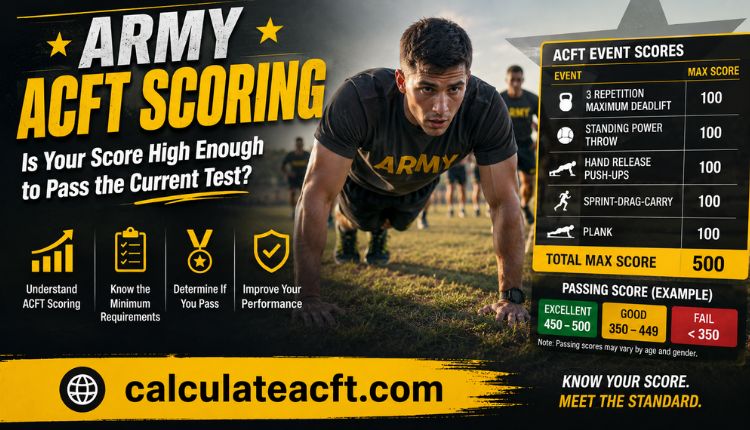
Army ACFT Scoring: Is Your Score High Enough to Pass the Current Test?
If you are looking up Army ACFT scoring, the most important thing to know is that the Army has already moved to the Army Fitness Test, or AFT, in official guidance. The current standards replaced the old ACFT score tables on June 1, 2025, and the Army now uses different pass requirements for most Soldiers and for designated combat specialties.
That change matters because a lot of older score charts and advice online are now outdated. The current system still centers on event-based performance, but the pass line is no longer something you should guess at. For most Soldiers, the benchmark is 300 points with at least 60 points in each event. For 21 designated combat specialties, the standard is 350 points with at least 60 points in each event.
This guide breaks down what the score means, how the current test is scored, which events count now, and the mistakes that make strong Soldiers fail on paper. If you are training for a record test, checking a scorecard, or trying to understand promotion impact, this article gives you the clean version without the fluff.
Army ACFT Scoring at a Glance
The Army ACFT scoring is simple at the top level: total your event points, make sure each event is at least 60, and compare your total against the standard that applies to your MOS or duty category. The Army states that the current AFT replaced the ACFT on June 1, 2025, and the old ACFT scoring tables were valid only until May 31, 2025.
| Category | Total score needed | Minimum per event | Applies to |
| General standard | 300 | 60 | Most Soldiers |
| Combat standard | 350 | 60 | 21 designated combat specialties |
The Army also notes that general AFT scores must be recorded in DTMS starting October 1, 2025, for promotion points, while combat standard scores must be recorded in DTMS starting January 1, 2026.
How the Current Scoring Works
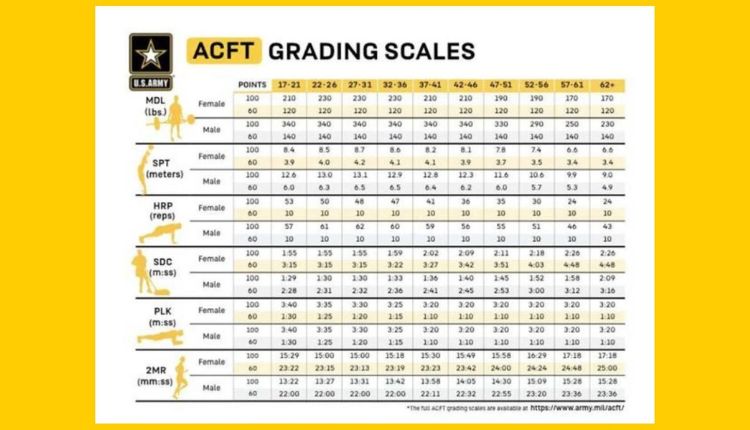
At the practical level, Army ACFT scoring is not about one huge total alone. It is a gate-and-total system. You need to clear the minimum in every event, and then your combined score determines whether you pass the applicable standard and how strong your result looks for readiness, promotion, and competitive standing. The Army’s official score tables also show point bands running from 0 to 100 for each event.
That means a Soldier can have a solid total and still fail if one event falls below 60. In other words, the weak link matters as much as the strong events. That is why smart training is event-balanced, not just run-focused or lift-focused.
The Events that Count Now
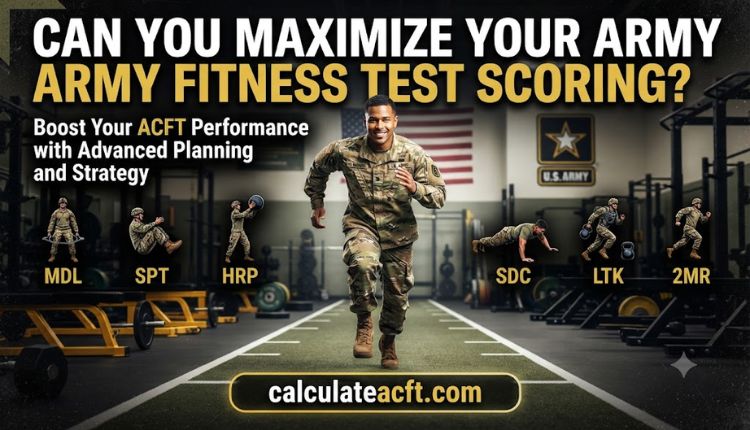
The current Army ACFT scoring centers on five scored events: the 3-Repetition Maximum Deadlift, Hand-Release Push-Up, Sprint-Drag-Carry, Plank, and Two-Mile Run. The Army removed the Standing Power Throw from the current test, saying it was taken out because of its technical nature and injury risk.
1) 3-Repetition Maximum Deadlift
This event measures lower-body, grip, and core strength. It rewards raw force production, but the Army ACFT scoring event description also stresses control, posture, and safe execution. That means sloppy form can cost you the lift even if you are strong enough to move the weight.
2) Hand-Release Push-Up
The push-up event is about upper-body endurance, not just chest strength. Soldiers have to complete as many correct repetitions as possible in two minutes, and the hand-release requirement makes cheating the standard much harder than in a normal push-up test.
3) Sprint-Drag-Carry
This is the event that exposes poor conditioning the fastest. It blends speed, power, anaerobic capacity, coordination, and change-of-direction work. If a Soldier trains only steady-state cardio, this event usually becomes a problem.
4) Plank
The plank measures core endurance and control. The Army requires a straight-line body position and gives graders authority to terminate the event if form breaks down. In scoring terms, this is one of the easiest events to underestimate because fatigue, not strength, is usually what ends the attempt.
5) Two-Mile Run
The run tests aerobic endurance and recovery capacity. The Army says it must be done on a measured, generally flat outdoor course, track, or improved surface, not unimproved terrain. This event still matters because it often separates a passing score from a competitive score.
What Changed from the old Army ACFT Scoring
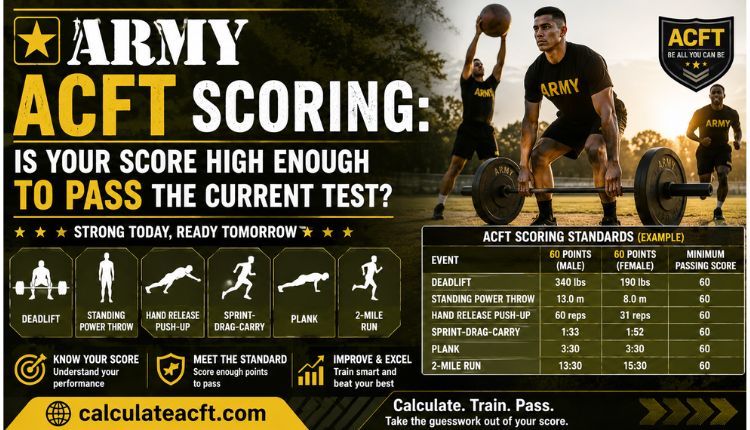
The biggest mistake Soldiers make is using stale Army ACFT scoring guidance and assuming nothing changed. The Army’s current official guidance says the AFT replaced the ACFT on June 1, 2025, and the old ACFT score tables were only valid through May 31, 2025. That means old screenshots, old score calculators, and old social posts can give you the wrong answer.
There is also a policy layer beyond the basic pass/fail standard. The Army published a directive stating that Soldiers who score 465 points or more on the AFT, with at least 80 points in each event and no alternate events, are exempt from body fat standards. That is not the same thing as simply passing, but it shows why high scores can matter well beyond the test itself.
Common Scoring Mistakes
The first mistake is treating the test like a single total-score competition; to know more click here. It is not. A Soldier must still clear the minimum event threshold, so one bad event can sink the entire attempt.
The second mistake is training to the old Army ACFT scoring and ignoring the current AFT setup. The removal of the Standing Power Throw changed how Soldiers should structure their preparation, especially if they were over-investing in explosive throwing practice.
The third mistake is forgetting that score reporting affects promotion points. The Army says general AFT scores must be in DTMS for promotion points beginning October 1, 2025, and combat scores beginning January 1, 2026. A strong score that is not recorded correctly can still create administrative problems.
How to Train for a Better Score
The smartest way to raise your Army ACFT scoring is to train the exact quality each event demands. Build deadlift strength with controlled pulling work, train push-up endurance with strict volume, practice shuttle-based conditioning for the Sprint-Drag-Carry, and improve your run by combining tempo work and interval work instead of only jogging. This is the most efficient path because it mirrors the test instead of guessing at it.
A useful rule is this: if one event is weak, do not let the rest of your program hide it. The passing score is built on balance. The Soldiers who score well usually do not just “have one strong event”; they have no obvious weakness. That is the difference between barely passing and actually looking ready.
FAQs
Is ACFT still the correct name?
The Army’s current official name is the Army Fitness Test, or Army ACFT scoring. Many people still search for ACFT scoring, but the current official standards are listed under AFT guidance.
What score do most Soldiers need to pass?
Most Soldiers need 300 total points with at least 60 points in each event.
Do combat specialties have a higher standard?
Yes. The Army says 21 designated combat specialties must reach 350 points total with at least 60 points in each event.
Is the Standing Power Throw still part of the test?
No. The Army removed the Standing Power Throw from the current test and said it was removed because of technical nature and injury risk.
How many events are on the current Army Fitness Test?
The current test uses five scored events: deadlift, hand-release push-up, sprint-drag-carry, plank, and two-mile run.
Can one bad event fail the whole test?
Yes. Every event must meet the minimum of 60 points. If one event falls short, the Soldier does not meet the standard.
Do old ACFT scores still count?
Army ACFT scoring recorded before May 31, 2025 were valid for promotion considerations until September 30, 2025. After that, the Army uses AFT guidance for promotion actions.
Why do high scores matter if I already pass?
High scores can help with promotion visibility, and the Army has also tied very high AFT performance to a body fat standard exemption under a separate directive.
Conclusion
Army ACFT scoring is really about two things: meeting the minimum in every event and building enough total points to clear the standard that applies to your category. The current Army rule is straightforward for most Soldiers: 300 total points, 60 in each event. For designated combat specialties, the bar is higher at 350 total points with the same per-event minimum.
The biggest takeaway is that the old ACFT score chart is no longer the current reference. If you are preparing now, train for the current AFT, use the current score tables, and make sure your performance is recorded correctly in DTMS. That is the cleanest way to turn training into a passing score and a stronger record.