Can You Pass the Army ACFT Standards 2024?
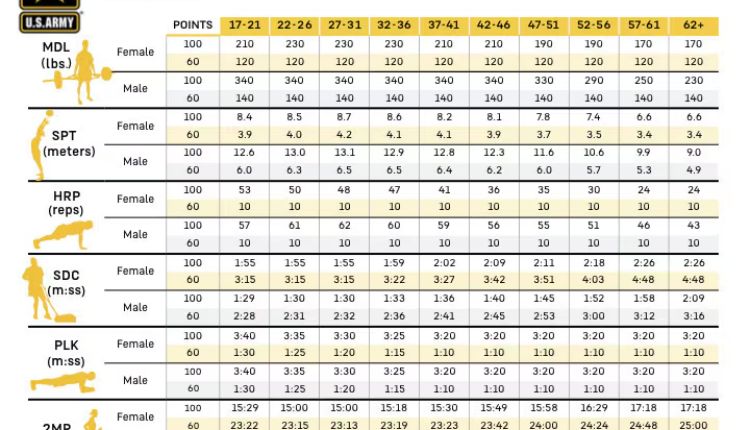
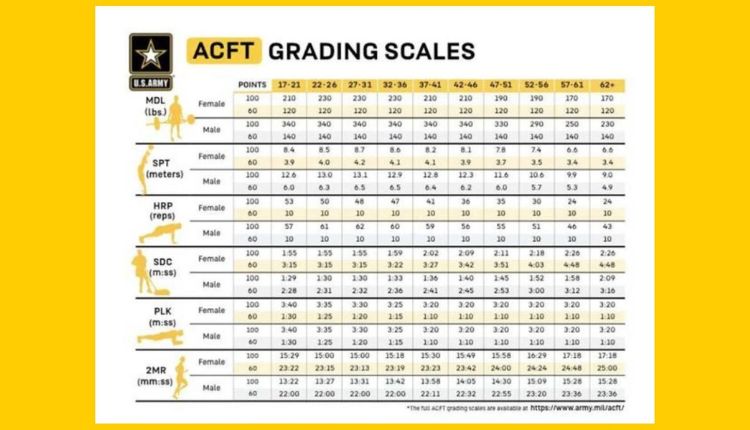
If you are searching for Army ACFT standards 2024, you usually want one thing: the exact rules that decide whether a Soldier passes, fails, or needs to train differently. In 2024, the ACFT was still a six-event record test, and the Army’s revised standard required at least 60 points in each event. The raw scores were age- and gender-normed, so the number on the scorecard had to be converted through the Army’s scoring tables before it counted. Those ACFT tables stayed in effect until the Army replaced the test with the AFT on June 1, 2025, which makes 2024 a stable and useful reference point.
That matters because many pages only show a chart and stop there. The real question is how the standard works in practice: what each event measures, how the scoring system works, what a passing result looks like, and what Soldiers should focus on in training. This guide gives you the direct answer first, then breaks the ACFT down in a way that is actually useful for study, prep, or publishing.
What the Army ACFT standards 2024 actually mean
The simplest way to read the Army ACFT standards 2024 is this: it was a six-event test, scored on a 0 to 100 scale per event, with a minimum passing score of 60 points in each event. The Army’s revised ACFT also used performance-normed scoring standards scaled to age and gender, which means the raw performance needed for the same point value could differ by category.
That is the key point many readers miss. A Soldier could not “make up” for one bad event by crushing another. In 2024, every event had to clear the minimum standard, and the test still required the full sequence of events in the official order.
The six events and what each one tests
1) 3-Repetition Maximum Deadlift
The deadlift is the first event, and it is the clearest strength test on the Army ACFT standards 2024. It asks a Soldier to lift the maximum weight possible for three repetitions, so the event rewards leg drive, grip strength, and safe lifting mechanics rather than speed alone. For most Soldiers, this is the easiest place to gain points quickly if technique and progressive loading are already in place.
2) Standing Power Throw
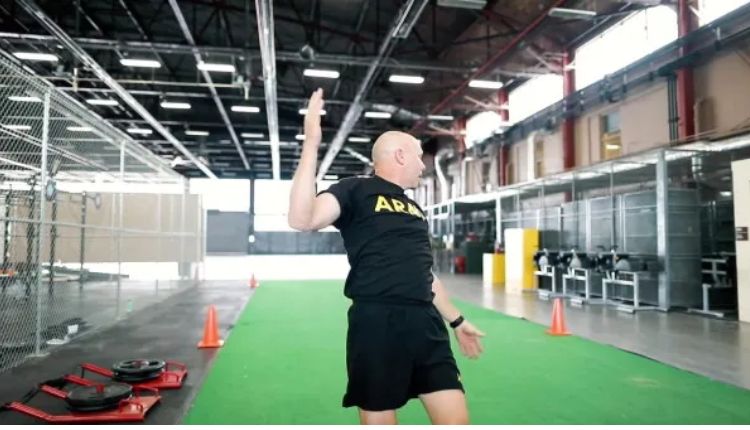
The standing power throw measures explosive power. In practical terms, it asks whether a Soldier can generate force quickly from the lower body and trunk, then transfer that power into an overhead throw. It is the event that exposes weak hip drive, poor sequencing, and lack of total-body coordination.
3) Hand-Release Push-Up
The hand-release push-up is the Army ACFT standards 2024 upper-body endurance event. Because each rep requires a full release at the bottom, it removes the short rest that some Soldiers rely on in ordinary push-up testing. That makes pacing, trunk tension, and repeatable pressing strength far more important than just being able to sprint through the first few reps.
4) Sprint-Drag-Carry
The sprint-drag-carry is the most “combat movement” style event on the test. It combines sprinting, dragging, lateral movement, and loaded carries, so it punishes poor conditioning and weak transitions between efforts. Soldiers who train only straight-line running often lose time here because the event rewards recovery under fatigue, not just raw speed.
5) Plank
By 2024, the plank had become the sole core-strength event on the Army ACFT standards 2024. That is important because it shifted the test away from hanging-based core work and toward sustained trunk stiffness, body-line control, and controlled breathing under tension. A Soldier who can hold the position with discipline usually performs better than one who treats it as a “survive until the clock stops” drill.
6) Two-Mile Run
The two-mile run is the final event and the most obvious aerobic endurance test. It matters because the ACFT is not just about strength or power; it also checks whether a Soldier can keep moving efficiently after five earlier events have already created fatigue. For many Soldiers, the run is where poor pacing earlier in the test becomes visible.
How ACFT scoring worked in 2024
In 2024, the ACFT scorecard converted raw performance into points using Army tables, to know more visit more. The official scorecard shows the event rows and the point conversion fields, and the Army’s revised scoring tables were still in force through May 31, 2025. The passing rule remained simple: 60 points per event.
The Army also kept alternate aerobic events for Soldiers with permanent profiles that prevented the two-mile run. Those alternatives included the 5,000-meter row, 12,000-meter stationary bike, 1,000-meter swim, and the 2.5-mile walk. That is a useful detail because many ACFT summaries leave out profile-based testing altogether, even though it was part of the official system.
If you want the cleanest way to summarize the 2024 standard for a featured snippet, use this: the Army ACFT standards 2024 required six events, 60 points in each event, and age- and gender-normed raw score conversions.
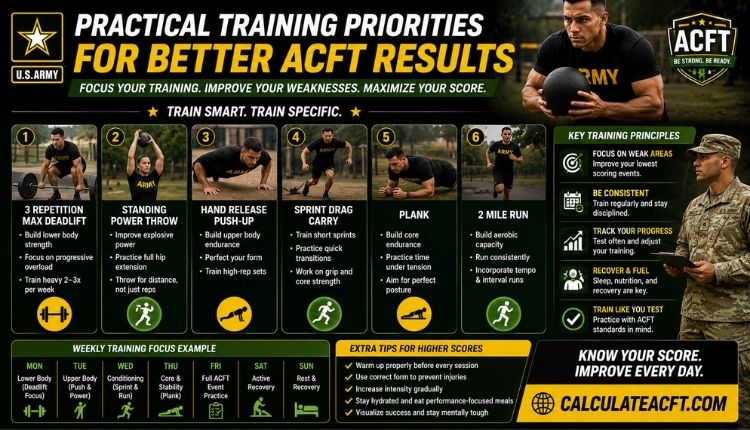
Practical training priorities for better ACFT results

The best training approach is to treat the ACFT as a balance test, not a single-lift contest. A Soldier who only chases deadlift numbers can still lose points on the plank, the run, or the sprint-drag-carry. A smarter plan is to identify the weakest event first, then build enough event-specific work to make that weakness disappear. That produces a more reliable score than trying to “peak” one event while neglecting the rest.
A second useful principle is pacing. The Army ACFT standards 2024 reward efficiency, especially on the hand-release push-up, sprint-drag-carry, plank, and two-mile run. Good test-day performance usually comes from staying controlled early, conserving enough energy for later events, and avoiding a hard blow-up in the middle of the circuit.
Finally, train movement quality, not just fatigue. Soldiers do better when they practice clean deadlift mechanics, repeatable push-up rhythm, efficient carry and drag transitions, and steady aerobic pacing. That style of training aligns with the Army’s broader focus on readiness and injury reduction through holistic fitness.
Common mistakes to avoid
The most common mistake is overvaluing one event. Many Soldiers want to max the deadlift and ignore the plank or the run, but the Army ACFT standards 2024 do not reward specialization the way some older fitness tests did. Another mistake is treating the sprint-drag-carry like a pure sprint; it is really a fatigue-management event with several movement patterns stitched together. A third mistake is sloppy plank form, where the Soldier survives the clock but loses the quality needed to hold a strong, legal position.
A fourth mistake is underestimating the transition cost between events. The ACFT feels different from isolated gym work because the body never fully resets between stations. That means the score you can hit in training is not always the score you can repeat under test conditions unless you practice the whole sequence.
FAQs
What was the minimum passing score for the ACFT in 2024?
The minimum passing score was 60 points in each event. A Soldier had to meet that standard across all six events to pass the test.
How many events were on the ACFT in 2024?
There were six events: deadlift, standing power throw, hand-release push-up, sprint-drag-carry, plank, and two-mile run.
Was the 2024 ACFT the same for everyone?
The test used age- and gender-normed scoring tables, so the raw performance needed for a point value could vary by category. The pass rule itself, however, still required 60 points per event.
Could a Soldier fail one event and still pass overall?
No. The Army ACFT standards 2024 required the minimum in every event, so one weak station could still cause a failure even if the total score looked strong.
What if a Soldier had a permanent profile?
Soldiers with a permanent profile that prevented the two-mile run could use alternate aerobic events such as the row, bike, swim, or 2.5-mile walk.
Did the Army change the ACFT after 2024?
Yes. The Army replaced the Army ACFT standards 2024 on June 1, 2025. That is why 2024 should be treated as the final full year of the ACFT standard before the transition.
What is the best way to prepare for the ACFT?
The best approach is balanced training: build strength, power, core endurance, aerobic capacity, and event-specific pacing instead of chasing one event and ignoring the others. That is the most practical way to avoid a weak link on test day.
Conclusion
The Army ACFT standards 2024 were straightforward once you strip away the jargon: six events, 60 points required in each one, and age- and gender-based raw score conversion behind the scenes. The test rewarded all-around performance, not just one strong lift or one fast run, and Soldiers who trained the whole sequence had the best chance of passing cleanly.
With the AFT replacing the ACFT in 2025, the 2024 standard now serves as a clear record of how the Army measured fitness at that stage. If you need a practical takeaway, it is this: train weak events early, practice the full order, and never assume one strong score can cover a weak one.