ACFT Scoring Chart
Unlike older fitness tests, the ACFT scoring chart measures strength, endurance, agility, and overall combat readiness. Understanding how the scoring chart works is essential for anyone preparing for the test, whether you’re active duty military, a recruit, or a fitness enthusiast.
Below is a detailed SEO-friendly 2000+ word guide with structured subheadings, bullet points, and FAQs to help you fully understand the ACFT rating system.
What is the ACFT Rating Chart?
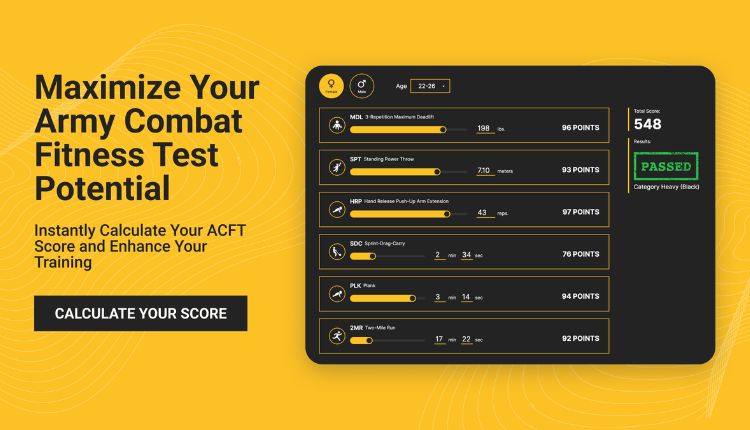
The ACFT scoring chart is a standardised system used to rate a soldier’s performance in six different fitness events. Each event is scored individually, and the overall score determines whether the soldier meets the required standards of physical fitness.
The ACFT replaced the older Army Physical Fitness Test (APFT) to better reflect actual combat requirements. Instead of focusing mainly on push-ups, sit-ups, and running, ACFT introduces functional movements that simulate battlefield activities.
Each of the six events is rated on a scale from 0 to 100 points. To pass the test, soldiers must achieve at least 60 points in each discipline with a minimum total score of 360.
Key features of the ACFT chart include:
- A six-event structure testing multiple fitness components
- Maximum total score: 600 points
- The minimum score for passing is 360 points
- Gender-neutral scoring standards (in updated versions)
- Performance considerations by age in some categories
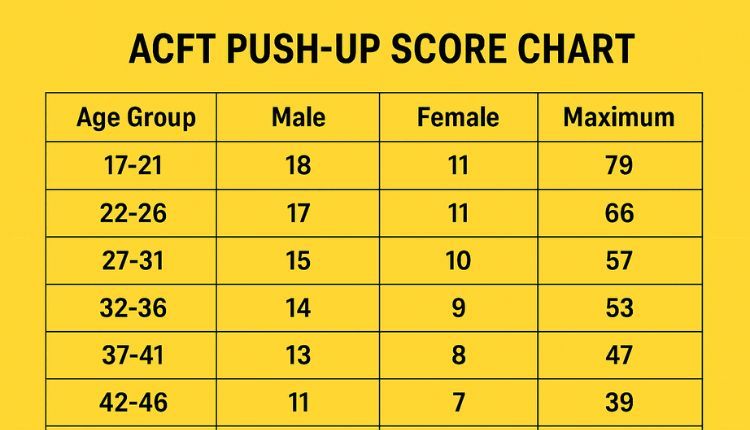
The scoreboard provides detailed ACFT Scoring Chart performance indicators, such as how much weight to lift or how fast to complete a run to earn a certain number of points.
Understanding this chart helps Soldiers set realistic goals and track their progress effectively. It also ensures fairness and consistency in physical readiness assessments across the military.
Overview of Six ACFT Actions
The ACFT scoring chart is built around six different events, each focusing on a specific aspect of fitness. These events are designed to simulate the physical tasks soldiers may encounter in real combat situations.
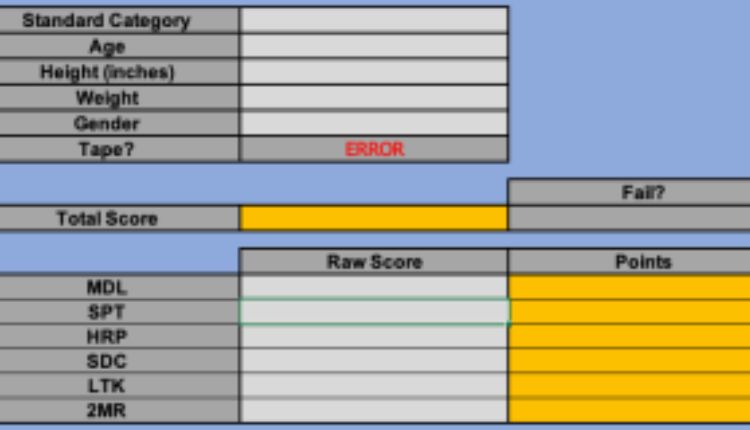
The six ACFT events are:
- 3-Repetition Maximum Deadlift (MDL)
- Standing Throw (SPT)
- Hand Release Push-Up (HRP)
- Sprint-Drag-Carry (SDC)
- Leg Tuck (LTK) or Plank (PLK)
- Two Mile Run (2MR)
Each event contributes equally to the total score, with a maximum of 100 points per event.
The purpose of each event is to:
- Deadlift: Measures lower body strength
- Power Throw: Tests explosive power
- Push-Up: Assesses upper-body endurance
- Sprint-Drag-Carry: Assesses agility and anaerobic endurance
- Leg Tuck/Plank: Tests core strength
- Two-Mile Run: Measures Cardiovascular Endurance
The variety of actions ensures a comprehensive assessment of the soldier’s fitness level. Unlike traditional tests, the ACFT focuses on functional fitness rather than isolated exercises.
Understanding each event is key because your performance in each directly affects your score on the ACFT Scoreboard.
How the ACFT Rating System Works
The ACFT scoring chart table ACFT Scoring Chart awards points based on performance in each event. The better your performance, the higher your score.
Each event has specific performance thresholds that correspond to point values. For example:
- Lifting heavier weights in the deadlift scores more points
- Completing more reps in a push-up increases your score
- Faster running and sprinting times lead to higher points
The scoring system works as follows:
- Minimum number of points to pass the competition: 60 points
- Maximum score per event: 100 points
- Total possible score: 600 points
Important scoring rules include:
- Failure of one event causes the entire test to fail
- Scores are cumulative across all six events
- Performance standards may vary slightly depending on policy updates
The scoring chart helps soldiers identify their strengths and weaknesses. For example, someone strong in endurance but weak in strength can adapt their training accordingly.
In addition, the Army uses a point system to determine promotion, assignment, and overall readiness.
ACFT Scoring Chart Categories and Standards
The ACFT scoring chart categorizes performance into different levels and helps Soldiers understand where they stand.
Common score categories include:
- Below Standard (0-59 points per event)
- Minimum standard (60 points per event)
- Medium performance (70-79 points)
- High performance (80-89 points)
- Elite Performance (90-100 points)
These categories help Soldiers set benchmarks for improvement.
Key standards include the following:
- A total score of 360 is required to pass
- Higher scores may be required for certain roles or units
- Combat roles often require higher fitness standards
The scoreboard also ensures fairness by applying consistent standards to all participants. While there may be some adjustments for age groups, the emphasis is on maintaining operational readiness.
Understanding these categories allows soldiers to aim beyond just getting by and strive for excellence.
Detailed Breakdown of the Evaluation of Each Event
Each event in the ACFT scoring chart ACFT Scoring Chart table has its own scoring criteria. Understanding these details can greatly improve your preparation strategy.
Here is the breakdown:
Deadlift (MDL):
- Heavier lifts result in higher scores. Maximum points are awarded for lifting the highest standard weight.
Standing Throw (SPT):
- The distance hit determines the score. Explosive power is key.
Cranks with manual release (HRP):
- The number of repetitions completed within the time limit affects the score.
Sprint-Drag-Carry (SDC):
- Faster completion times earn higher scores. This event tests speed and endurance.
Tuck/Plank (LTK/PLK):
The score determines the number of repetitions or duration.
Two Mile Run (2MR):
- Faster times result in higher scores.
Tips to improve your score:
- Focus on proper technique
- Train consistently in all fitness areas
- Track your progress with the scoreboard
Knowing how each event is scored allows for targeted training and better overall performance.
Significance of the ACFT Scoreboard in a Military Career
The ACFT scoring chart plays a key role in a soldier’s career progression. It is not just a test of fitness but a measure of preparedness and discipline.
Key impacts include:
- Promotion: A higher score ACFT Scoring Chart can improve the chances of promotion
- Tasks: Some roles require a higher level of fitness
- Retention: Sustained failure can affect career stability
- Readiness: Ensures soldiers are physically ready for missions
The ACFT is also used as a yardstick for evaluating a soldier’s overall performance. It reflects a soldier’s ability to perform in physically demanding conditions.
For recruits, an early understanding of the scoring chart can help build a solid foundation for success.
Tips to Improve Your ACFT Scoring Chart
Improving your ACFT scoring chart requires a well-rounded fitness approach. As the test covers multiple areas of fitness, training should be balanced.
Effective strategies include:
Strength training:
- Focus on compound exercises like deadlifts and squats
Cardio workouts:
- Improve endurance with running and interval training
Basic exercises:
- Improve board performance and foot tuck
Agility exercises:
- Practise sprinting and lateral movements
Consistency:
Train regularly and monitor progress
Other tips:
- Follow a structured exercise plan
- Follow a healthy diet
- Treat yourself to plenty of rest and regeneration
- Practise test-specific movements
Using the ACFT Scorecard as a guide will help you set realistic goals and measure improvement over time.
Common Mistakes and How to Avoid Them
Many soldiers struggle with the ACFT scoring chart due to avoidable mistakes. Understanding them can help improve your performance.
Common mistakes include:
- Neglecting certain events
- Bad technique
- Lack of preparation
- Ignoring recovery
How to avoid them:
- Train all six events equally
- Learn proper form for each exercise
- Follow a consistent training schedule
- Include rest days in your routine
Another big mistake is focusing only on passing and not excelling. Aiming for higher scores can improve overall fitness and career opportunities.
By avoiding these mistakes, you can maximize your performance on the ACFT scoreboard.
Wrapping It Up
The ACFT scoring chart is more than just a scoring system – it’s a comprehensive tool designed to measure a soldier’s physical readiness for modern combat. With six different events covering strength, endurance, agility and power, the ACFT provides an all-around assessment of fitness.
Understanding how scoring works, the standards required and how to improve performance is critical to success. Whether your goal is to pass, excel, or achieve elite performance, the ACFT scoring chart provides a clear roadmap.
By training strategically, avoiding common mistakes, and consistently tracking your progress, you can significantly improve your scores and overall fitness.
Frequently Asked Questions
- What is the minimum score to pass the ACFT?
The minimum number of points to pass is 360 points, with at least 60 points required in each discipline.
- How many events are there in ACFT?
There are six events: deadlift, power throw, push-up, sprint-drag-carry, plank/leg tuck, and two-mile run.
- What is the maximum ACFT score?
The maximum score is 600 points, with 100 points per action.
- Can you fail one event and still pass overall?
No, failure of any single event causes the entire test to fail.
- Is the ACFT grading table the same for everyone?
The military has moved toward more gender-neutral standards, but some variations may still apply.
- How often do soldiers take the ACFT?
Soldiers typically complete the ACFT twice a year, but this can vary.
- What is the hardest ACFT event?
This depends on individual ACFT Scoring Chart strengths, but for many, sprint-pull-carry and two-mile runs are challenging.
- How can I improve my ACFT score quickly?
Focus on consistent training, proper technique, and using a scoreboard to set goals.